



For 35 years, systems thinking has remained frustratingly abstract – intellectually compelling but operationally elusive. LEGO® Serious Play® Build Level 3 changes that by making invisible systems tangible and explorable.
From Real Time Strategy to Systems Thinking
The original Build Level 3 application, Real Time Strategy (RTS), was designed in the early 2000s for business strategy. Whilst it contained breakthrough thinking, leading practitioners now recognise its rigid, prescribed sequence didn’t serve diverse strategic challenges.
New Build Level 3 applications have evolved beyond RTS. The SeriousWork Systems Thinking Model© operationalises Donella Meadows’ elegant definition: ‘A system is an interconnected set of elements that is coherently organised in a way that achieves something.’
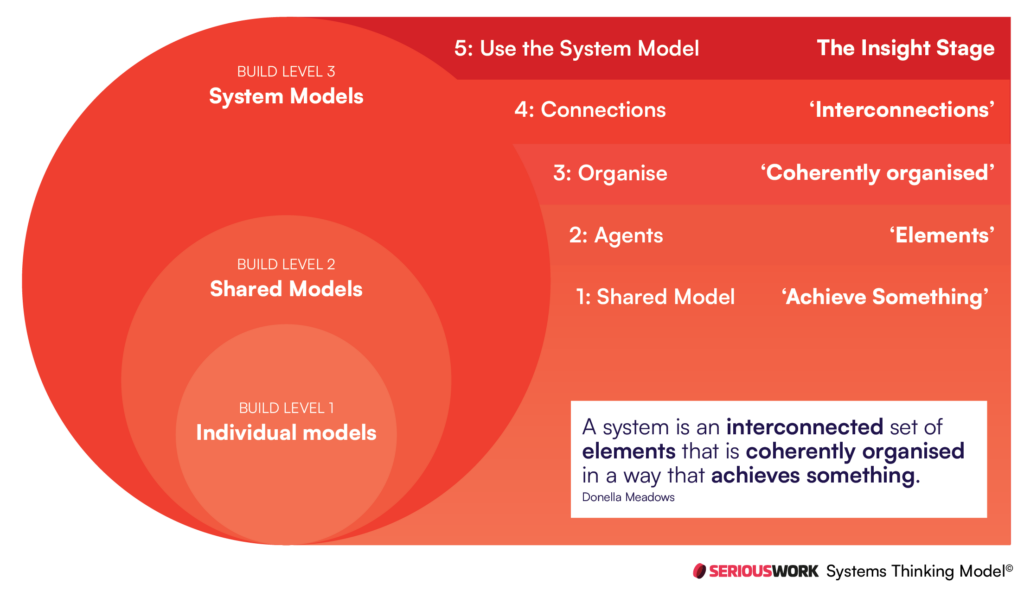
This framework isn’t prescriptive – it’s conceptually grounded in how systems actually work, serving contexts from organisational strategy to change initiatives, from product development to team dynamics.
How LEGO® Serious Play® Enables Systems Thinking
Making Systems Visible
Abstract complexity becomes concrete. Groups build three-dimensional models where every force, factor, and relationship is visible and tangible. The entire system sits on the table, explorable by all.
Democratic Participation
Everyone builds. Everyone shares. Position doesn’t determine voice. The physical nature transcends language barriers and hierarchical dynamics in ways verbal discussion cannot.
Creating Psychological Safety
When ideas are objectified in models rather than personally owned, teams can examine ‘what the model shows’ without defending positions. Vulnerability becomes possible because no one is personally attacked when assumptions are questioned.
Engaging Metaphorical Thinking
Language fails to capture complexity. A LEGO® brick can represent ‘hope’, ‘resistance’, ‘transformation’ – concepts that physical metaphor expresses more powerfully than words.
The Five-Stage SeriousWork Process
Stage 1: Build a Shared Model – ‘Achieve Something’
What is this system trying to accomplish? Typically a vision, but could be understanding current reality.
Stage 2: Build Agents – ‘Elements’
What forces, factors, or influences affect this system? Multiple rounds identify 30–40+ agents.
Stage 3: Organise – ‘Coherently Organised’
How do these agents relate to each other and the vision? Spatial positioning reveals relationships.
Stage 4: Build Connections – ‘Interconnections’
How do agents influence each other? Physical connections make feedback loops and leverage points visible.
Stage 5: Use the System Model – Insight Stage
What can we learn? This adapts to organisational needs – identifying leverage points, testing scenarios, examining assumptions.
What Makes This Different
Traditional systems thinking tools – causal loop diagrams, stock-and-flow models – remain abstract, static, and expert-dependent. They embed one person’s perspective rather than representing collective understanding.
LEGO® Serious Play® Build Level 3 is fundamentally different:
- Shows wholes, not fragments – complete systems visible simultaneously
- Dynamic and interactive – elements can be moved, connections tested
- Collectively owned – built together, representing genuine shared understanding
- Naturally engaging – people lean in and build on each other’s insights
The Re-Vision© Technique
After examining the system, groups refine their original vision based on what they’ve learned. This isn’t ‘we got it wrong’ – it’s ‘we think more sophisticatedly now’.
The refined vision incorporates elements that were missing, modified priorities based on seeing the whole, and strategic grounding that wasn’t visible initially. Comparing before and after reveals the difference: the refined version is invariably richer, more detailed, and more strategically sound.
Integration with The Fifth Discipline
Build Level 3 creates powerful visualisation. But without Peter Senge’s Fifth Discipline framework, workshops risk remaining at surface level.
The Fifth Discipline provides:
- Strategic framework for what to look for – leverage points, feedback loops, mental models
- Conceptual coherence – understanding you’re developing the five disciplines
- Transferable language – teams can recognise systems thinking patterns
- Independent capability – competence teams can use independently
Beyond Visualisation: Dialogue Depth
Making systems visible is necessary but insufficient. David Bohm’s practice of collective inquiry creates the reflective depth that transforms visibility into genuine learning.
After building system models, Dialogue enables:
- Suspension of assumptions rather than defending positions
- Examination of mental models shaping the system
- Collective intelligence emerging from thinking together
- Behavioural change – insights embedding as transformed capability
The combination is powerful: LEGO® builds create tangible focus whilst Dialogue creates transformation depth.
When Build Level 3 Serves Best
This approach excels when:
- Facing genuinely systemic challenges where multiple forces interconnect
- Needing strategic thinking depth beyond quarterly planning
- Building capability that persists after workshops end
- Developing the collective intelligence AI cannot replicate
Investment and Outcomes
Typical Build Level 3 workshops require two to three days for comprehensive system exploration, leadership commitment to sustained practice, and ongoing capability development.
The investment delivers systems made tangible and collectively explorable, strategic insights identifying leverage points, capability development through practice on real challenges, and foundation for sustained systems thinking practice.
Learn More
Experience Build Level 3 firsthand – attend our public training programmes
Bring it to your organisation – commission a strategic workshop applying Build Level 3 to your actual challenges
Build internal capability – train facilitators who can lead systems thinking work independently
Read The Systems Synergy – understand how LEGO® Serious Play®, The Fifth Discipline, and Dialogue integrate to make systems thinking operational