



For decades, systems thinking has suffered from a visualisation problem. Leaders understand intellectually that ‘everything connects’, yet lack tools to make those connections visible and discussable with their teams. Abstract diagrams require specialist expertise. Causal loop models remain static on whiteboards. Computer simulations hide assumptions in code.
The result? Systems thinking stays trapped in the domain of consultants and academics whilst leadership teams desperately need it.
The Breakthrough: Making Systems Tangible
The SeriousWork Systems Thinking Model© solves this through a deceptively simple insight: transform Donella Meadows’ elegant systems definition into a facilitated building process using LEGO® bricks.
Meadows defined a system as ‘an interconnected set of elements that is coherently organised in a way that achieves something’. Each component of that definition becomes a distinct stage of collective exploration.
The five stages aren’t prescriptive steps to follow mechanically. They’re conceptually grounded in how systems actually work, serving diverse contexts – from organisational strategy to change initiatives, from product development to team dynamics.
Stage 1: Build a Shared Model – ‘Achieve Something’
Every system exists to accomplish something. Stage 1 makes that purpose tangible.
Participants first build individual models responding to carefully crafted questions: ‘What does success look like two years from now?’ or ‘What future are we creating together?’ After sharing individual perspectives, table groups combine key elements into shared models showing collective vision.
This isn’t about wordsmithing vision statements. It’s about making invisible aspirations visible – externalising what people actually think and hope for, not what corporate communications produces.
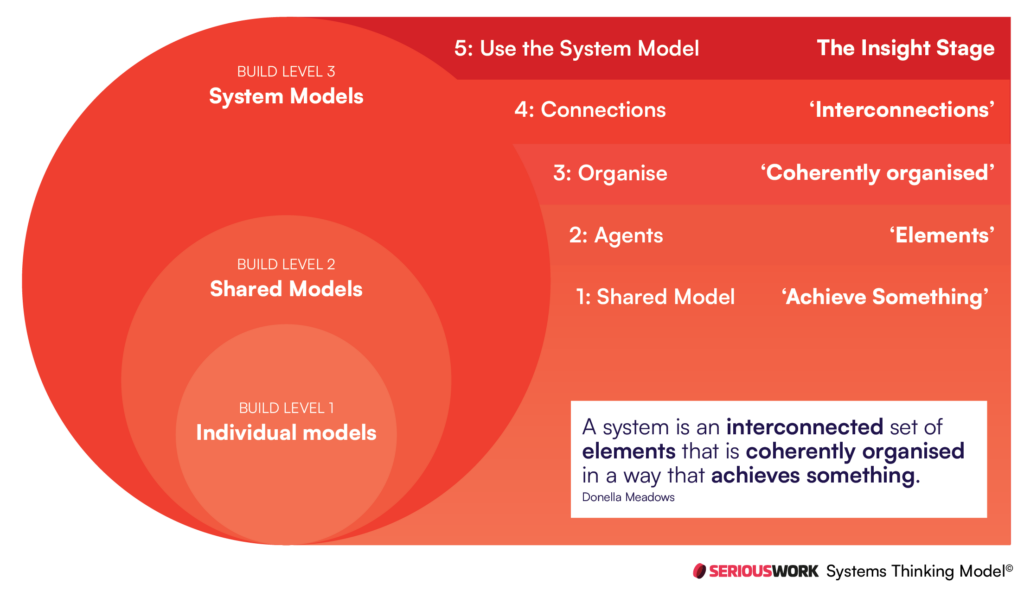
Stage 2: Build Agents – ‘Elements’
What forces affect whether that vision becomes reality? Stage 2 identifies them.
Through multiple building rounds, participants create 30–40+ agent models representing everything affecting the system: market dynamics, internal culture, competitor actions, regulatory environment, technology changes, resource constraints, leadership behaviours, customer expectations.
Each agent is a small LEGO® model with a story. ‘This red brick represents fierce competition – it’s sharp, aggressive, always present.’ ‘This clear dome shows transparency – we can see through it, but it’s also fragile.’ The metaphorical thinking captures complexity that analytical language cannot.
Stage 3: Organise – ‘Coherently Organised’
How do these agents relate to each other and the vision? Stage 3 positions them spatially.
Participants arrange agents on the table according to proximity, influence, and relationships they perceive. Which agents sit close to the vision? Which are peripheral? Which cluster together? Which stand isolated?
This three-dimensional layout reveals understanding impossible to capture in lists or spreadsheets. The spatial relationships show priorities, dependencies, and patterns that only become visible when the whole system is laid out physically.
Stage 4: Build Connections – ‘Interconnections’
Now the systems thinking becomes explicit. Stage 4 builds the connections showing how agents influence each other.
Using LEGO® connector bricks and strings, participants physically link agents whilst explaining each relationship: ‘Strong leadership support enables innovation funding.’ ‘Regulatory uncertainty constrains market expansion.’ ‘Internal culture either amplifies or dampens customer focus.’
As connections multiply, patterns emerge. Which agents are most connected? Where do feedback loops exist? What reinforcing cycles amplify change? What balancing forces maintain stability? The web of connections makes system dynamics tangible and discussable.
Stage 5: Use the System Model – Insight Stage
With the complete system visible – vision, agents, spatial relationships, connections – Stage 5 generates strategic insight.
This stage adapts to organisational needs. Some groups identify leverage points where small interventions create disproportionate impact. Others test ‘what if’ scenarios by manipulating the model. Some examine feedback loops, others explore unintended consequences, still others surface mental models shaping how they see the system.
The flexibility matters. The same five-stage process serves a charity exploring their mission, a data science practice developing strategy, or a leadership team navigating digital transformation.
What Makes This Different
Traditional systems thinking tools embed one person’s perspective – typically the consultant or systems expert who creates the diagram. The SeriousWork model inverts this: the system emerges from collective intelligence, built collaboratively, owned by everyone.
The physical three-dimensional nature enables exploration impossible with static diagrams. Elements can be moved, connections tested, scenarios played out. The model invites experimentation rather than passive observation.
Most importantly, the tangibility creates psychological safety. When examining ‘what the model shows’ rather than defending personal positions, genuine inquiry becomes possible. The LEGO® bricks hold the difficult truths, enabling groups to think together about complexity without defensiveness.
After 35 years of systems thinking remaining frustratingly abstract, the practical methodology finally exists – not through theoretical innovation, but through recognising how physical building makes invisible systems visible, tangible, and collectively explorable