



Any intelligent fool can make things bigger and more complex… It takes a touch of genius - and a lot of courage to move things in the opposite direction
Albert Einstein Tweet
I recently shared a post about Hexagonal Thinking. It offered a glance of how participants used this method as part of a short program that I designed and facilitated for the Forest Governance, Markets and Climate team as they looked to co-create a conceptual wireframe for their new Knowledge Management System (KMS).
A number of people expressed a desire to see a write up regarding how I used Hexagonal Thinking for the program that I designed for the FGMC. This article is specifically catering to this demographic – those who are looking for an instructional ‘how-to guide’ for how you might use Hexagonal Thinking for mapping complexity in your particular setting or context*
*This checklist that I put together to accompany this article will hopefully also prove helpful
First, a bit of a primer…
A Quick Introduction: What is Hexagonal Thinking?
Hexagonal Thinking is a visually engaging and collaborative strategy tool that uses hexagonal cards to represent individual concepts, ideas, or data points.
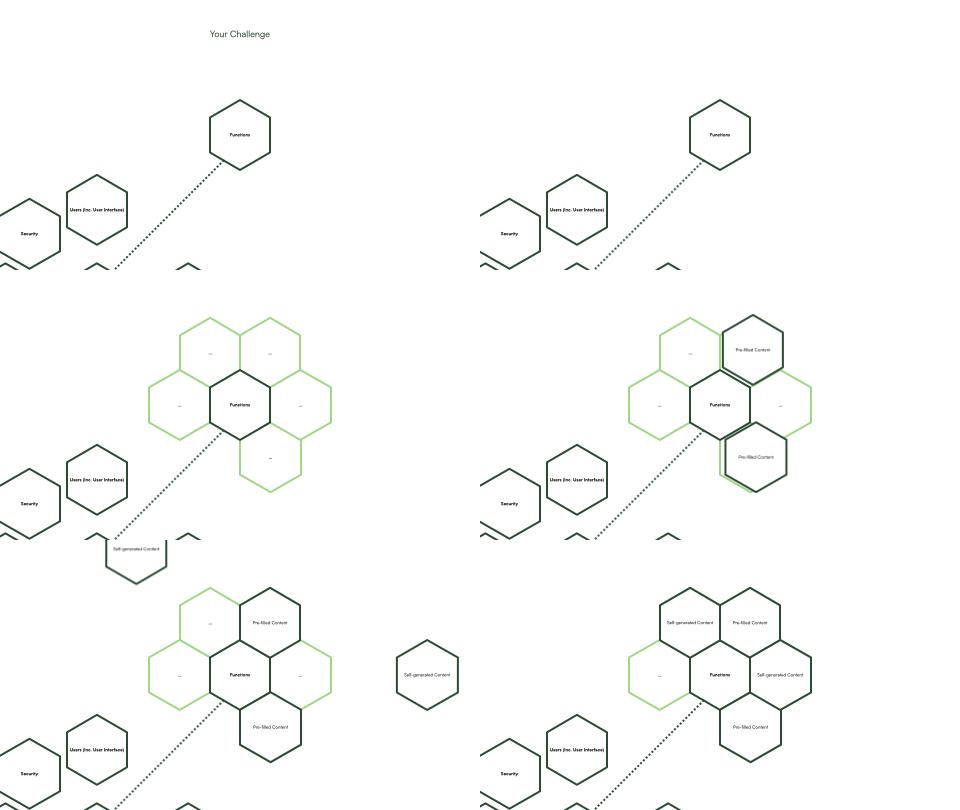
The power lies partly in the hexagonal shape itself: any side of a hexagon can connect to any other side of another hexagon – a lot like the structure of a classic beehive. This gives participants the opportunity to identify and explicitly show multiple connections and interdependencies that exist between concepts – helping to more effectively map and navigate complexity. It moves teams beyond simple lists and rigid hierarchical frameworks, into a rich, associative web of knowledge; often visually represented as thematically interrelated clusters.
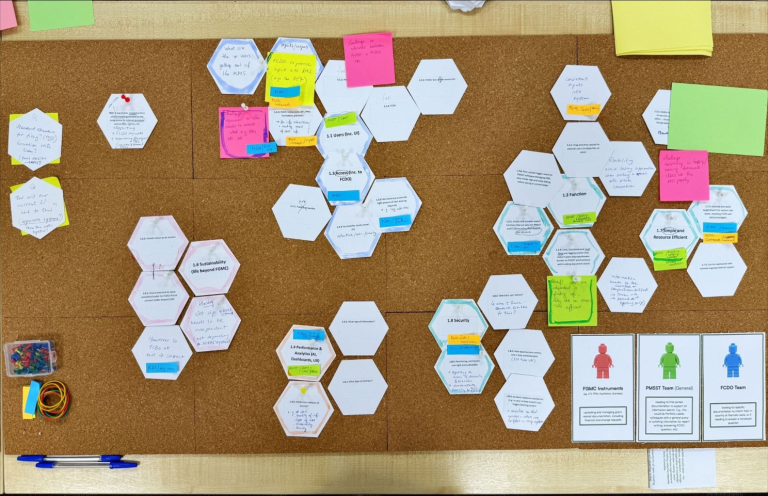
The use of movable hexagonal tiles allows participants to rapidly iterate; constructing and then reconstructing their conceptual map in response to ongoing reflection and insight. This iteration leverages principles of Constructivism (Vygotsky, 1978), where learning is an active, collaborative process of building knowledge, rather than passively receiving information.
A How To Guide for Using Hexagonal Thinking
This is a step-by-step guide for how I used Hexagonal Thinking to support the group from FGMC that I was recently working with. As they were co-creating a wireframe for their Knowledge Management System, the method was chosen for its ability to co-construct a visual representation of the interrelated complex web of knowledge that would eventually make up the KMS.
Phase One: Preparation
It will come as no surprise that – in my humble opinion – the secret to success is in the preparation. I worked closely with my clients at FGMC to prepare in advance for the program we ran. Here are a couple of the key factors I considered before we even got to the venue.
- Pre-defined Content: For many concept mapping exercises, some of the content (key concepts and ideas) will be known in advance (this could be central ideas, critical questions, curriculum content, or even product features – in the case of a KMS). Other concepts will emerge during the mapping process itself. I worked closely with my clients at FGMC to create a matrix of the key concepts that we knew were important enough to be considered prior to the event. These were linked to key strategic objectives and were informed by development drivers that were identified as important by a small focus group that represented key stakeholders. I was then able to use this data to create a set of pre-made tiles for the mapping exercise, saving time on the day that allowed the group to immediately begin the process of identifying and mapping connections and relationships.
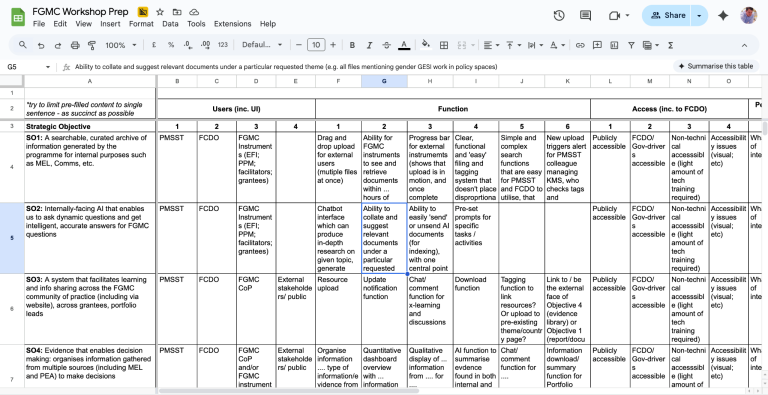
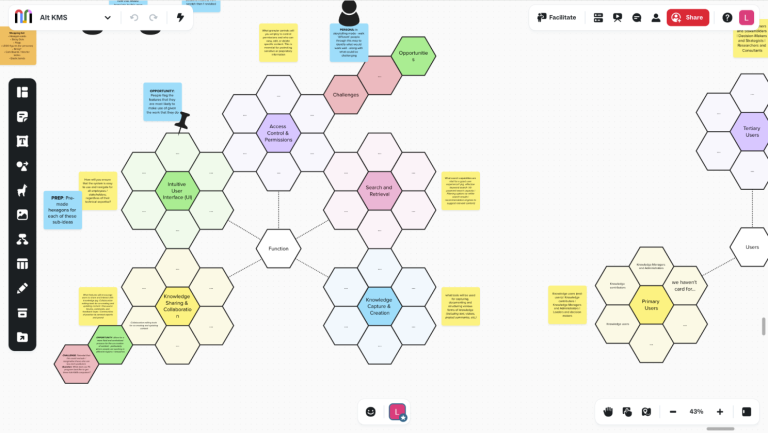
- Method of Delivery: Hexagonal Thinking works both as an in-person or online tool for concept mapping. Decide which environment (physical or virtual) would work best for your assignment; both have their pros and cons. Once you have decided on your approach, you can then resource accordingly by creating either physical card hex-tiles for in-person mapping, or a series of digital ones for a virtual environment.
Top Tips:
For physical tile prep., I find it easiest to type up the content using a template and then print this onto labels that I can then stick directly onto tiles. This is much quicker than trying to write this content out by hand; particularly if you have 100’s of tiles to produce.
For virtual mapping, consider using a digital whiteboard that will make it easier for multiple participants to collaborate and co-construct at one. MURAL and Miro are both great examples.
Phase Two: Setup
As with pre-session prep., the setup immediately preceding a Hexagonal Thinking mapping exercise is central to its success. Here are a few things that I like to focus on when setting up:
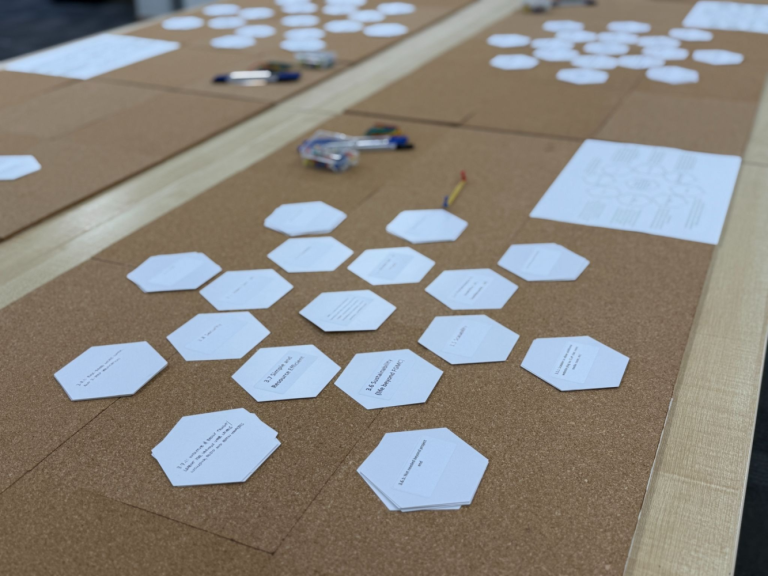
- Physical Environment: How will you get people to build their map? On a wall; on a table; on the floor? For the FGMC case study, I favoured tables covered in cork board. The horizontal plane makes it easy to move and rearrange tiles without them falling off. The cork allows you to pin tiles in place to mitigate unwanted movement. I often used rolls of paper in classrooms to allow students to draw arrows and connectors between clusters. As with most things, the answer to which approach works best is: it depends…
- Groupings: If it is a large group – and a complex map – who will be working with what concepts; and with who! In some instances, multiple groups can work with “all” the materials available; essentially mapping the same complexity, as they see it from their unique perspective. For larger, more complex concept-mapping exercises, it might prove more effective to split the group into sub-groups, each working on a different ‘piece of the puzzle’. This is what we did with FGMC; giving each sub-group a different strategic objective for the KMS, and challenging them to map out the key wants and needs related to that objective using the relevant design drivers.
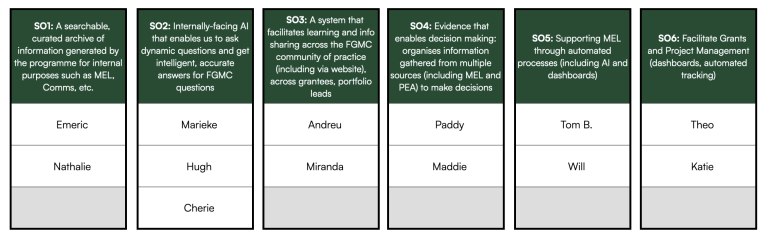
- Capacity: Linked to the above; how much time do you have available for the activity, and what human resources will be in the room. Giving groups limited time to map complex systems will likely result in breadth or depth of thought, but perhaps not both together.
- Starting point: How will you present the hexagon tiles to participants? Will they be laid out on the table?; stacked into thematic piles; will there be an implied initial structure?. Think carefully about how you are presenting materials to your participants as this can heavily influence the extent to which they feel they have agency to organise them as they see fit.
- Room to Grow: We have talked about pre-defined content, but what about the concepts and ideas that emerge through the mapping process. I have lots of blank tiles on hand to allow for just that. I also encourage people to scribble questions and thought on any tiles as they see fit to capture and articulate thinking. Coloured pens, post its and sticky dots can also be helpful to quickly (and visibly) represent thinking.
Phase Three: Facilitation
If you do your preparation and setup right, this is actually the most enjoyable and – dare I say it – easiest phase of facilitating an exercise in Hexagonal Thinking. Your primary role is to simply keep things moving along; lubricating the process.
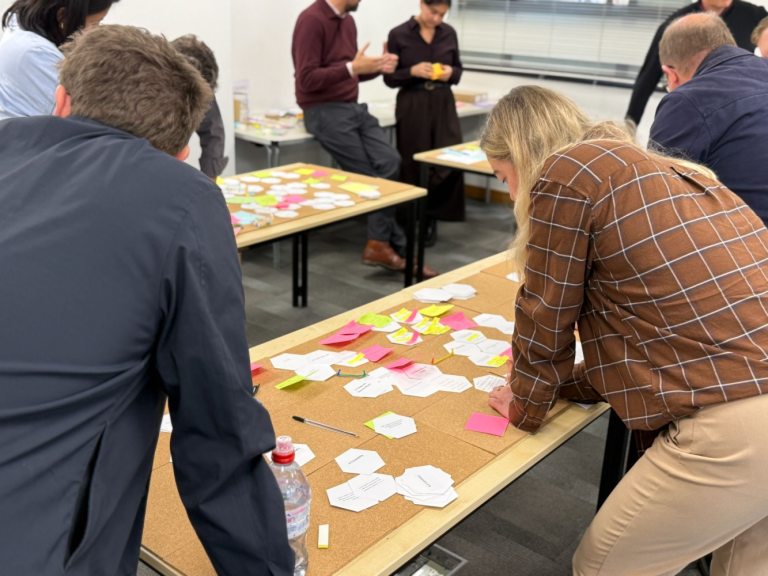
- Clear expectations: I’m still a teacher at heart, and this one is CRITICAL! Before you begin, it is important that participants have a clear understanding of the learning process they are about to embark upon. Why is this work important? What are the key rules and expectations? And what exactly does success look like? I always find it is helpful to have visual guides to walk people through these – either as a physical demo or a clear set of slides clarifying process and work-flow. Make sure you chunk these up so that you do not overload folk with too much information at once.
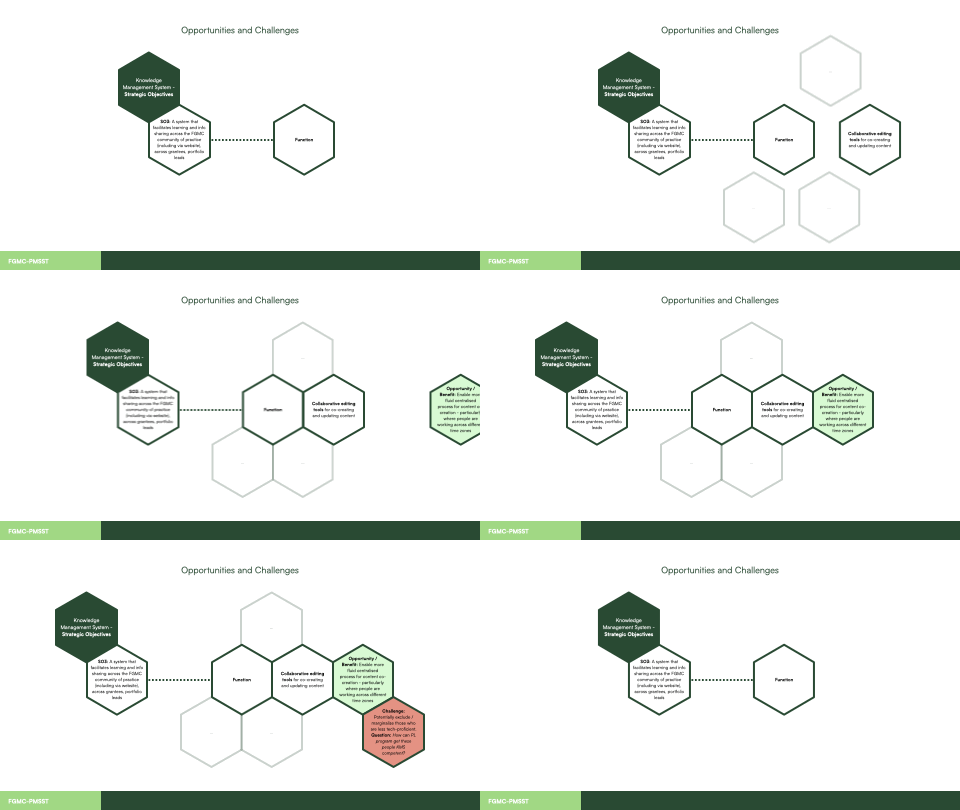
- Modelling: Linked to the above, there is no better way of understanding a (potentially confusing) process than to see it in action. Take the time to walk the group through the Hexagonal Thinking methodology so they are absolutely crystal clear on how to use it.
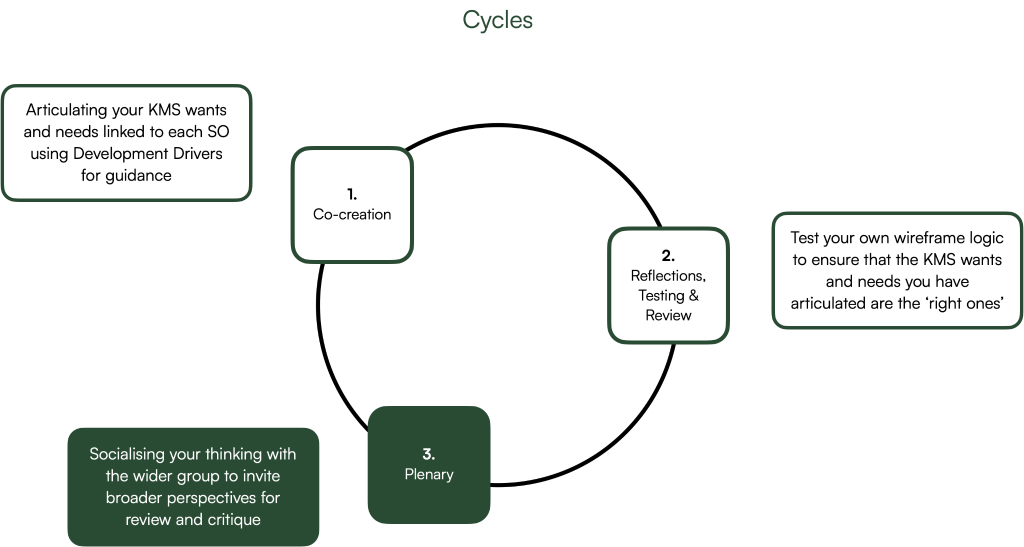
- Build cycles: Complex mapping can take time – but people lose energy and focus if asked to engage in a single activity for prolonged periods. This is why I introduce the concept of build cycles for hexagonal thinking; breaking up rounds of co-creation with structured reflection and socialising key reflections in plenary. For the FGMC gig, we engaged in three such cycles before a process of storytelling to round things off.
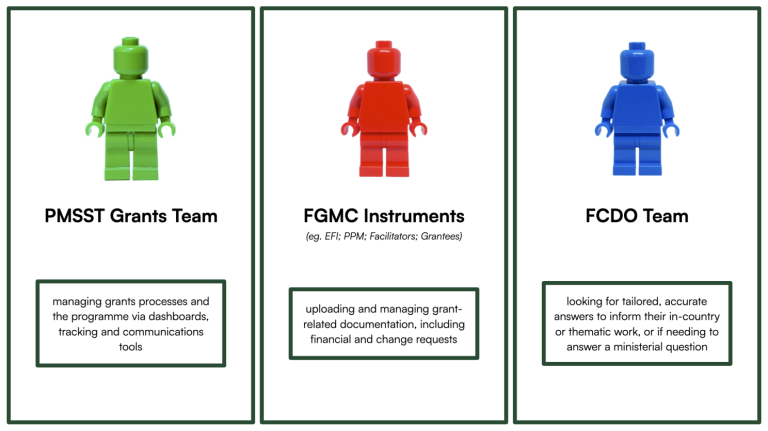
- Powerful Reflections: How will you encourage participants to challenge, test and review the concept maps they construct. There are lots of options, including thinking frameworks such as ‘See, Think, Wonder’, and de Bono’s thinking hats to force perspectives. A favourite method of mine – and the one I used with FGMC – is personas. Working with my clients beforehand, we designed typical personas with typical use-cases (ways they would likely interact with the KMS). Participants then introduced these personas into their concept maps to try and understand how it helped or hindered them, in line with the nature of their hypothetical interactions.
- Your role: A good facilitator of learning knows when to step in and support, and when to let participants get on with it. I tend to let people get on with it during periods of co-creation; leaving some of my more general feedback on process to the plenary parts of each build cycle. This way, my interventions do not break concentration and flow.
Post Production: “So, now what?”
The best facilitated workshops can become completely useless if no thought is given to how the outputs and stories generated are captured and used beyond the confines of the workshop itself. Hexagonal Thinking is no different. Here is some food for thought re: what you might consider:
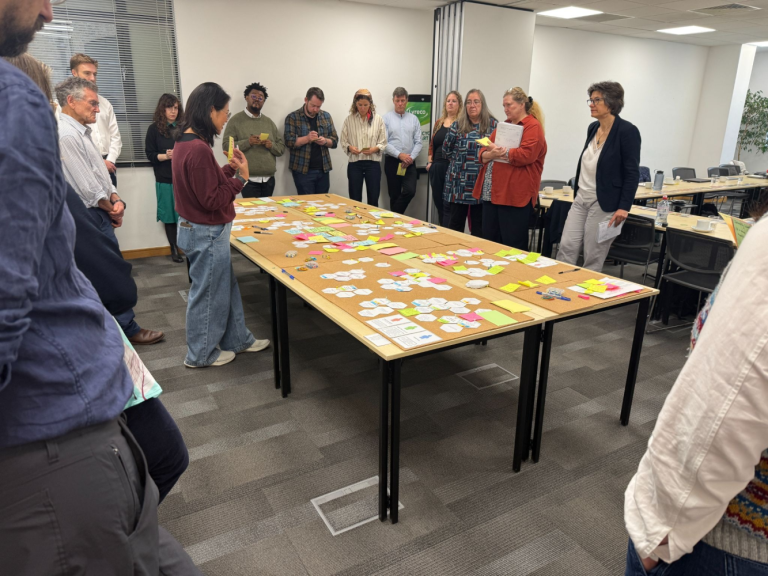
- Storytelling: Stories are compelling. We have evolved to put great stock in stories and they serve to build connections between people and ideas. I finish any Hexagonal Thinking activity by getting groups to share the story of what they have created. This not only socialises the key thinking that has taken place, but it also acts as a great opportunity for data capture…
- Record the stories: I use my trusty phone to capture the story, ideally getting the group to use the map as a scaffold to tell the story; guiding my camera through it using a pointy stick. This way, people who did not attend the workshop can still access the stories that emerged from it
- Take pictures: Birdseye pictures of concept maps make it easy to identify the interrelationships between concepts, as well as the key clusters that were formed.
- AI: What blog would be complete without some reference to AI? For the FGMC workshop, I used Gemini to capture the stories as they were told by each strategic objective sub-group. My friendly Google friendly tech partner then summarised and synthesised the key ideas from six stories (almost 45 minutes of storytelling and reflection) into a pretty damn good two page synopsis. (Word of warning, carefully read through and check any synthesis of data before presenting it as a coherent overview of any group think!)
So there you have it, there is my take on how you might use Hexagonal Thinking to help participants map and navigate complexity in your setting or context. Of course, like all tools, it is not perfect and has its limitations, but for certain applications, it really is a fantastic – and relatively easy to access – method.
I hope this article was helpful – let me know how you get on!