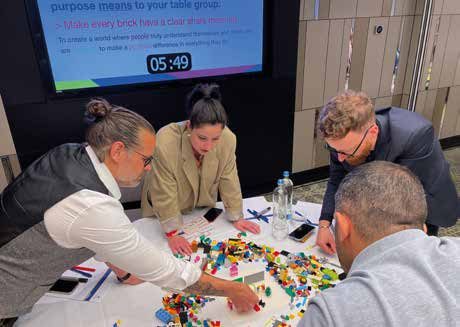
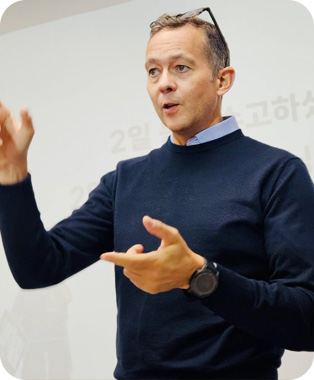
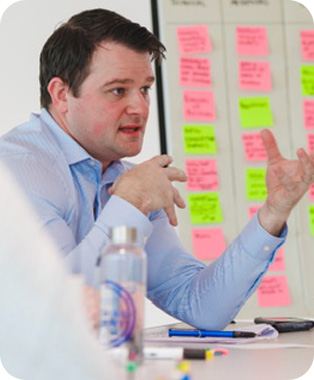
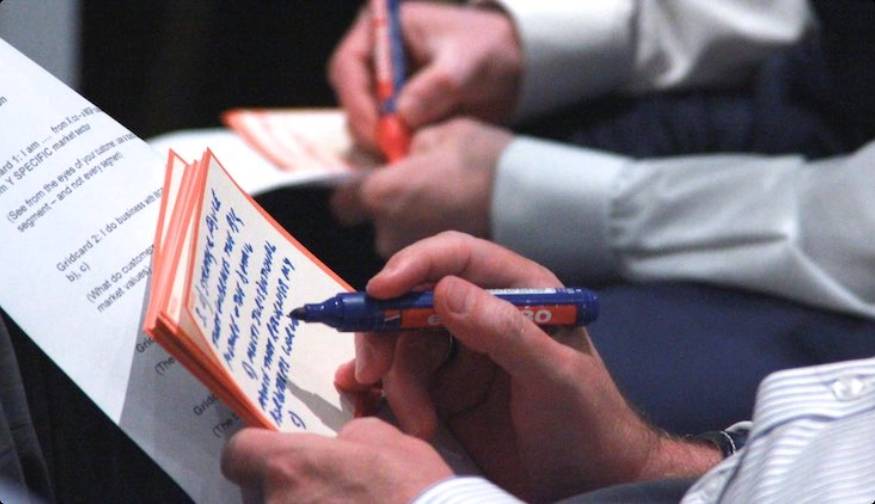
A workshop participant writes their own view on a card

Our approach

Let's suppose your organisation creates exactly the behaviour it is designed to produce.

What if your team could see what's already going on, and talk about it honestly?

What's already going on

The limit isn't competence. It's conditions.

Those conditions show up through one of three doorways: strategy, leadership or culture. They look like separate problems. They're one system, which is why fixing one on its own rarely lasts.

Strategy

"We have a strategy. It just isn't changing what people do."

What usually sits behind it

A plan written for the organisation rather than built with it, and forces nobody has mapped that quietly pull it off course.

What changes

Your team builds the future it wants together, so the plan is theirs and they act on it.

The Oxera story →

Leadership

"Every one of us is capable. Together we keep going round in circles."

What usually sits behind it

Each leader running their own part well, with no shared picture of how the parts push on each other.

What changes

Leaders see how their parts push on each other, and start thinking as one team.

Talk to us about your leadership team →

Culture

"Change programme after change programme, and the old patterns come back."

What usually sits behind it

Change announced to people rather than made with them, so the old patterns return as soon as attention moves on.

What changes

People make the meaning themselves, so the change holds when attention moves on.

The Insights Group story →

If your problem is technical and the answer is already known, you don't need us.

How the work usually runs

Five steps, whichever door you came through

Every engagement is shaped around your organisation, but most follow these five steps. The first starts from the symptom you can see and finds the pattern behind it.

The five steps form a cycle: diagnose, shape the work, see the system, design experiments, act, reflect and learn, then back to diagnosing.1Diagnose2Shape3See the system4Experiment5Act and learnONE CYCLE,REPEATED
The cycle repeats. Each time round, more of it is run by your own people.
  1. 1

    Diagnose your patterns

    We talk with you and a few of your leaders, and use the Strategic Pattern Diagnostic, to find the pattern behind the symptom you came in with.

    You leave with A clear view of what is technical and what is systemic, before anyone commits to a programme.

    Typically You and a few senior colleagues: a conversation each, plus the 20-minute diagnostic.

  2. 2

    Shape the work

    Together we decide who needs to be in the room, which questions matter most, and over what time.

    You leave with A design that fits your organisation and your calendar, not a standard package.

    Typically You as sponsor, with us, over two or three conversations.

  3. 3

    See the whole system, together

    Your senior team builds its vision, maps the forces acting on it and connects them into one model, then thinks together about what it shows.

    You leave with One shared picture of the system, the few points where action matters most, and a vision the team has built and owns.

    Typically Your senior team, together, for one to three days.

    See step 3 at Oxera ↓

  4. 4

    Design leverage experiments

    The team chooses the few places where a small change will shift the whole system, and designs small tests instead of a big programme.

    You leave with A short list of experiments, each with an owner and a clear question it should answer.

    Typically The same team, at the end of the workshop or soon after.

  5. 5

    Act, reflect, learn

    You run the experiments, return to the model to see what the system did, and decide what next. Then round again.

    You leave with Evidence of what works in your organisation, and growing capability to keep going without us.

    Typically The owner of each experiment, a review with us, and your own facilitators if you choose to train them.

Check
Sean to confirm the 'Typically' lines, especially the time asked of senior people at each step.

Inside step 3

Inside the work at Oxera, stage by stage

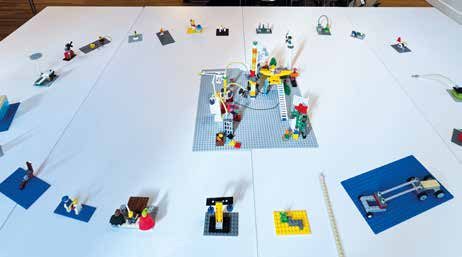
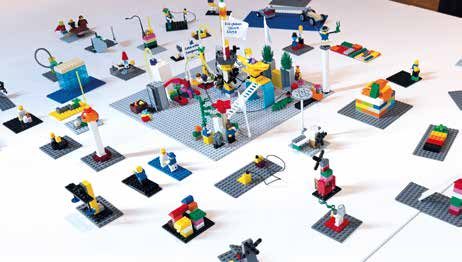
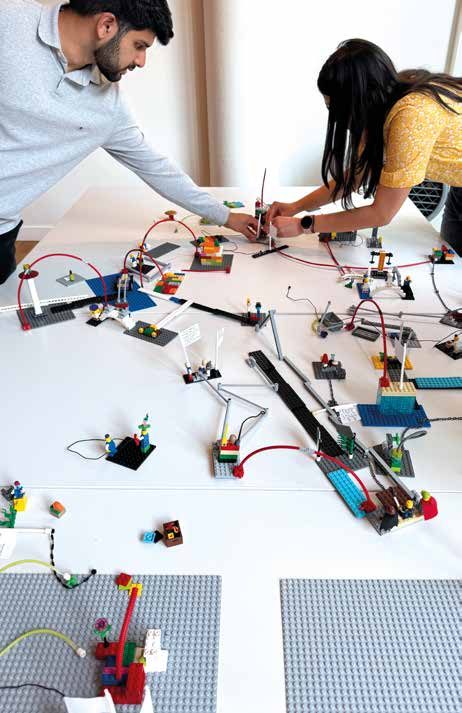
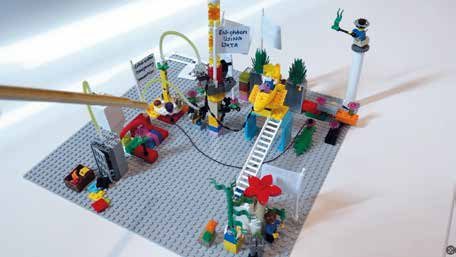
Data scientists and economists, from junior staff to board level, built their vision and the system around it, one stage at a time. The method is the SeriousWork Systems Thinking Model©, which turns Donella Meadows' definition of a system into five stages a team can build.

  1. Oxera's first Meta-Model©: everyone's vision in one model1Each person's vision, combined into one
  2. Agents built at Oxera2The forces that help or block it
  3. Agents organised around the vision3Organised around the vision
  4. Building connections between the agents4Connected: where influence flows
  5. Re-Vision©: refining the vision after seeing the system5Re-Vision©: the vision refined
"He took a group of 28 smart, diverse, yet also critical data scientists and economists ... and led us to a unified vision for our Data Science practice."Dr Sebastian Wernicke, Partner, Oxera

The question your colleagues will ask

Is LEGO® serious enough for our executive team?

It is the most serious thing in the room.

Senior teams are fluent in slides and strategy papers, and that fluency is part of the problem. It lets assumptions pass unexamined, and it lets the most confident voice set the direction.

Building removes that cover. Every person puts their own thinking on the table, in a form others can see and question. Disagreement becomes something the team can point at, not someone it has to confront. And for the first time, the whole system sits in front of the whole team at once.

The method was never designed as play. LEGO® Serious Play® was developed in the 1990s by Johan Roos and Bart Victor, then professors at IMD in Switzerland, to help managers describe, create and challenge their views of their business. Professor Victor wrote the foreword to our book, The Systems Synergy.
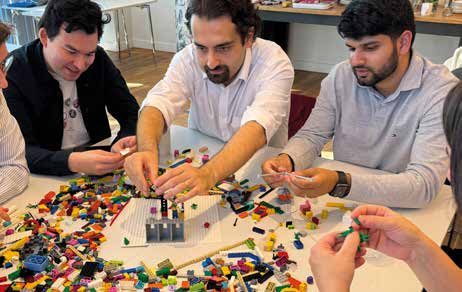
Leaders at The Insights Group each building their own answer at a shared table
At The Insights Group: each person builds their own answer first, so every voice is on the table before the discussion starts.

Designed for change that lasts

Built by the people who have to live it

Most change fades because it was done to people. Psychologists Edward Deci and Richard Ryan showed that people sustain change of their own accord when three needs are met: autonomy, relatedness and competence. Every step of our work is designed to meet all three.

Autonomy

Commitment replaces cynicism

Your team builds its direction rather than receiving it, so it owns what it built.

Relatedness

Trust that survives pressure

Dialogue around the models makes the undiscussable discussable, and that changes how the team works on a hard day.

Competence

Capability, not dependency

Your people learn the discipline of seeing the system, so they can keep doing it without us.

Who is in the room

The people who design your work are the people who run it

You won't meet a partner at the pitch and a junior team on the day. Every engagement is led by one of us, with associates from our network where the scale of the work needs them.

Sean Blair

Sean Blair

Founder

Has designed and led strategic work for senior teams since 2000, for organisations including Google, HSBC and Pfizer. Developed the SeriousWork Systems Thinking Model© and wrote The Systems Synergy.

Liam Isaac

Liam Isaac

Director of Learning and Innovation

A learning designer with 20 years' experience. Designs the workshops and programmes behind much of our client work, for capability that lasts, not just a good day.

Check
Sean to confirm that every engagement is led by Sean or Liam.

Our associates and the two companies behind us →

Ways to begin

How much do you want to commit at the start?

Each option runs the same five steps. What changes is how many times you go round the cycle, and how much of it your own people learn to run.

Option 1 Buy

Experience it first

Organisations that want to see it work before committing further.

Steps 1 to 4 once, with a follow-up session to start step 5.

Who runs it We do.

What you get
  • Design conversations with you beforehand
  • One strategic workshop with your senior team, over two to three days
  • Agreed leverage points and a refined vision
  • Photos and video stories of every model
  • A follow-up session
Timeline
Six to eight weeks from first contact to workshop

Option 2 Hybrid

Pilot programme and training

Organisations ready to commit, but wanting to invest in stages.

The whole cycle, over six months.

Who runs it We do, with your people learning alongside.

What you get
  • Two- to three-day workshops over six months
  • Internal facilitators trained alongside, apprenticing in the early workshops
  • Proven value from the first work, and capability emerging in-house
Timeline
Two to three months from decision to first workshop

Option 3 Build

Committed development

Organisations facing significant systemic complexity that needs sustained capability.

The cycle repeated, until your people run it themselves.

Who runs it Your people, with us on the highest-stakes work.

What you get
  • External expertise for your highest-stakes work
  • Internal facilitators trained and certified
  • Multiple workshops, training and materials
  • A commitment to ongoing practice
Timeline
90 days to first workshop; 12 to 18 months to basic capability
Check
Sean to confirm the mapping of each option to the five steps.

We often work alongside a client's existing consultancy or programme partner, as design partner and co-facilitator.

Investment depends on scope and scale. The Executive Brief sets out typical ranges, and we will give you a clear figure after a first conversation.

Not sure which doorway you're standing in?

The 20-minute Strategic Pattern Diagnostic shows which patterns are strongest in your organisation and which way to begin suits them. Or simply talk to us.